
Patricia Smith Wood tagged me in the Blog Hop sweeping the internet for writers. I’m to reveal my innermost writing secrets. Also I’ve tagged two other engaging authors. I’ll tell you who they are at the end of my post.
Thanks, Pat, for giving me this opportunity. We were friends in our early teens then I moved to Wyoming and we lost touch. When I moved back to Albuquerque twenty-years later, our friendship reignited. As preteens, Pat never let us be idle. That girl could play the piano and sing her heart out. At sleepovers, she made us sing for hours. Loved it, but I sounded like a sick Muppet. Thank goodness she no longer insists I sing.
Something else, her father was an F.B. I. agent– So cool because I was the girl who, under the blankets with a flashlight, read all the Hardy Boy Mysteries (the early ones before they watered down the rich vocabulary). I couldn’t get enough of sleuthing. Patricia’s father’s stories about an unsolved New Mexico murder stirred up her imagination and eventually turned these ideas into her first book, The Easter Egg Murder. You can learn more about Patricia Wood by visiting her website here.
1) What am I working on?
Right now, I’m looking for an agent/publisher for Cuba Libre Conspiracies, and I’m busy with my next book, Illusive Inheritance (working title) the second in this Beth Armstrong mystery series.
Illusive Inheritance is the sequel to Cuba Libre Conspiracies, but it’s also a stand-alone where Beth surprises her husband with a dream vacation in the Caribbean that turns into a nightmare when she realizes they’ve survived a murder attempt.  Beth’s obsessiveness in finding answers annoys everyone, even a Rastafarian drug runner who may have murdered a young girl’s mother. Beth befriends a Voodouist who knows much about the past and more than she cares to tell.
2) How does my work differ from others of its genre?
Having a protagonist who’s a middle-aged woman scientist working in a research institute sets Cuba Libre Conspiracies way over on the unique side for most commercial fiction mysteries. Another aspect that’s less common these days is a story told completely from the protagonist’s point of view. Dialogue-rich writing is something I enjoy as a reader, and I also like to write. This keeps a snappy pace to my stories without needing long, intricate descriptions. I know readers’ imaginations can fill in holes better than anything I could describe. Most of my secondary characters are multidimensional, allowing them to make assumptions, mistakes, and even rethink.
Some mysteries do have a protagonist who struggles with deeply conflicted emotions. But in my stories, my protagonist is also headstrong in her biases before she understands things are not at all what they seemed.
Much of my writing inspirations have come from cherished authors such as Alice Hoffman’s with her lyrical writing, Elizabeth George and Ian McEwan’s characters with strong and conflicted emotions, Michael Connelly sensitivity, and Robert Parker’s snappy dialogue.
3) Why do I write what I do?
It’s okay to hear voices, but it’s not okay to answer them, right? I not only hear voices, they entertain me with stories. Sometimes a relative, friend, stranger, or co-worker’s voice won’t get out of my head. What if my characters have some of these particular voices?
Sitting in a science review committee meeting, I watched an emotional but contained interplay between the chairman and a researcher. We weren’t privileged to some prior history between them, but when the researcher slapped the table with his open hands, pushed his chair back and looked away, I knew the chairman just found out something important and had won. What if a science institute is rife with corporate espionage and no one believes it except for one scientist?
One step farther: What if a busy professional woman, barely holding her marriage together, is the scientist who no one believes her research was actually sabotaged? Interesting, but not compelling. What if at this same time, this woman unwillingly becomes the caretaker of an estranged aunt who’s a sloppy chain-smoker and who holds a nightly cocktail hour complete with roaring 20’s stories?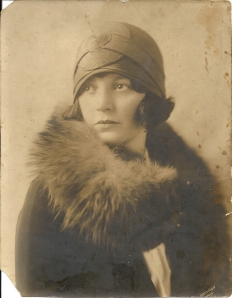 What if this aunt also aggravates by serving regular doses of advice on how fix a marriage and solve all that corporate intrigue?
What if all of this causes the woman scientist to discover her carefully controlled life, with her preconceived biases, no longer works? To eradicate the evil seeping through the science institute, she changes, mends her marriage, puts her life in danger, and uncovers an old family secret.
4) How does my writing process work?
Pansters, for those of you who don’t know, is a writer who sits at the computer and writes without outlining or maybe even a hint of where the story’s going. When I first started writing I’d type with only a vague plot in my head. I’d end up with too many subplots, too many boring scenes, and hit too many dead ends.
I found this a time waster.
I now begin with tons of research, with printouts, and note cards stacked next to my computer. I get a new spiral notebook and write the title of the book on its cover. In it I map out the plot. This is also where I write complete character sketches of my protagonist, antagonist, and all the secondary players. I make a time line, pick the inciting moment, and decide who did what to whom and when. I put a new small notebook in my purse to jot down ideas, scenes, voices I hear, actions I see, or anything I might want to use in the story.
Next I do a quick write. This is something Anne Greenwood Brown wrote about, click here. I find it helpful to quickly get into the first few chapters of my book. I then go back and actually do my real writing.
I get other eyes to give me feedback and help me see what I’ve missed. I’m a terrible proofreader.
Without doubt, the most enjoyable part of all is revision: cutting, cutting, cutting, reorganizing, replacing words with better words, getting rid of what’s trite, and transforming it into a newly created world.
Next Week: Meet Catherine Dilts and Paula Paul
Catherine Dilts and Paula Paul are tagged “it” for next Monday, August 4, 2014.
Catherine Dilts and I met when we were assigned to be on a short-story panel, almost two years ago at Left Coast Crime in Colorado Springs. Both of us are fascinated with geology, paleontology, and mineralogy. How could we not like each other? Catherine’s been generous in her email knowledge and advice whenever I’ve been flummoxed over some little writing thing.
Catherine writes amateur sleuth mysteries set in the Colorado mountains. In her debut novel Stone Cold Dead-A Rock Shop Mystery, business is as dead as a dinosaur, but when Morgan Iverson finds the body of a Goth teen on a hiking trail, more than just the family rock shop could become extinct. Book two in the series, Stone Cold Case, has an anticipated release date in 2015. Morgan Iverson reopens a cold case and lots of unhealed wounds in the small mountain town of Golden Springs when she discovers the bones of a popular and beautiful young woman who went missing fifteen years ago. Catherine works as an environmental scientist, and plays at heirloom gardening, camping, and fishing. Alfred Hitchcock Mystery Magazine has published three of her short stories, with The Last Real Cowboy appearing on the cover of September 2014 issue. Visit her at http://www.catherinedilts.com/
Paula Paul and I first met at SouthWest Writers many years ago when the organization was called South West Writer’s Workshop. She’s published at least two dozen books, historical, mysteries, and even a young adult story. Paula received her Bachelors in Journalism and is a state and national award-winning journalist. She’s also altruistic, donating one-third of the royalties from Crazy Quilt (published by UNM Press) to cancer research.

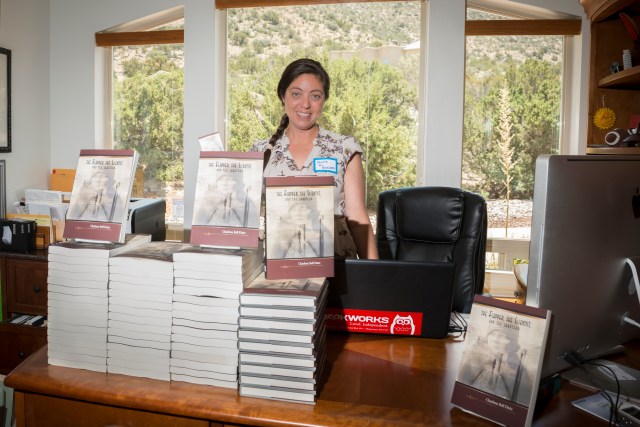
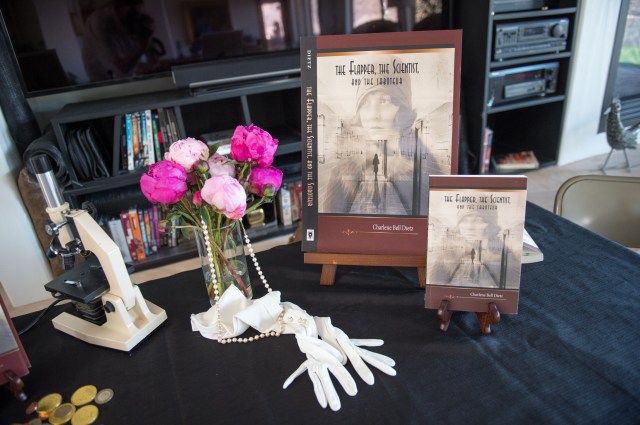
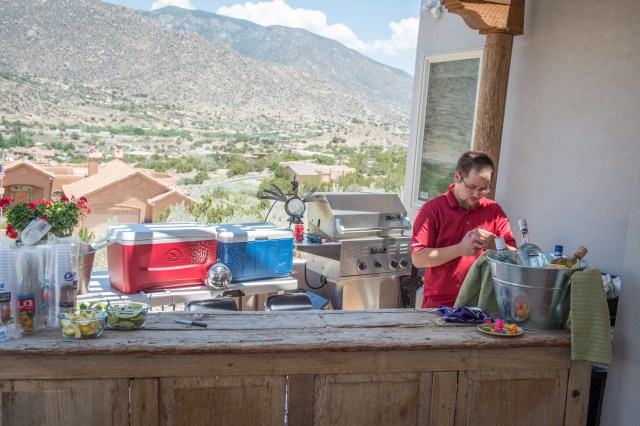
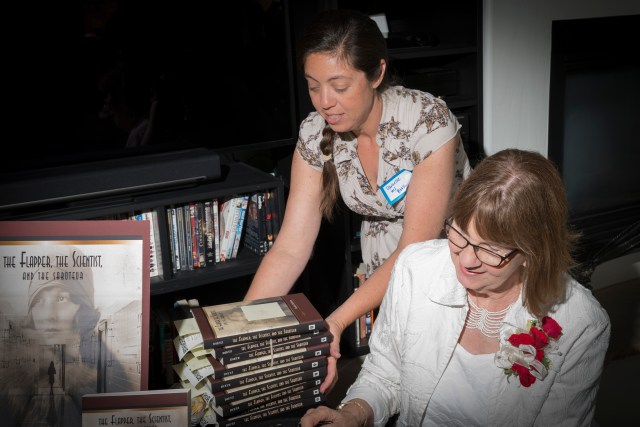
 Several years after I started writing, one of my dearest friends said, “When this book gets published, I’m throwing a huge party.”











 CHARLENE BELL DIETZ, Author: Inkydance Studios